
The short answer: To get recommended in AI chatbot answers, a company has to publish its own facts where engines like ChatGPT, Gemini and Perplexity can read them. If it doesn't, the engine pulls from somewhere else, sometimes a fake or dead store. Start with one crawlable page of official answers built from customers' most common questions, have your search team check AI answers monthly, and get senior leaders publishing first person content.
When I first saw the numbers, they reminded me of something companies used to do in traditional search. A competitor would publish SEO content that ranked for your brand name. Look up your company and you'd find an article comparing you to them, written by them, saying the competitor is better. It worked because the company didn't have enough information out about itself. LLMs have the same weakness. Unless a company has its facts correct and keeps updating the content going out, it has no footprint on the LLMs and isn't controlling the narrative. Someone else will come in, control the facts and drive traffic away.
The new version is worse, because now the machine does the recommending. Podqi’s study of AI shopping answers about 151 brands asked ChatGPT, Gemini and Perplexity the same five shopping questions and reviewed every website named in 6,795 answers. 9% of AI shopping answers showed the shopper a risky website. Of 4,437 domains reviewed, 718 were risky: 351 fake and 367 dead.
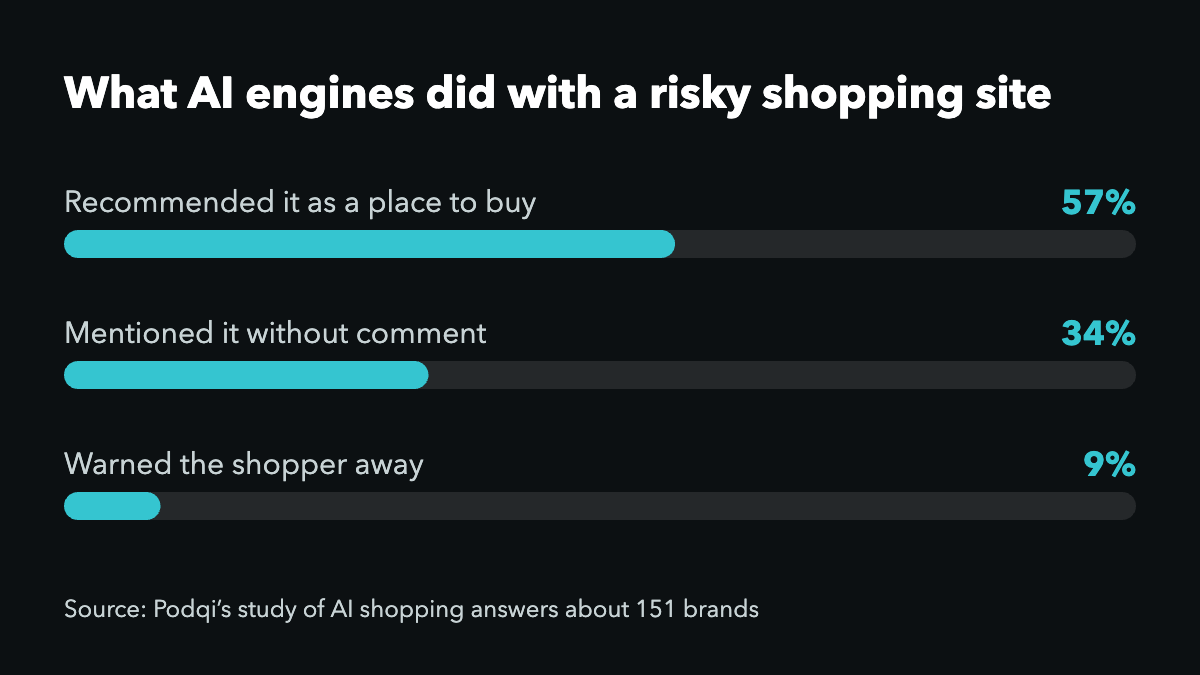
What the engines did with those sites is the part that worries me. 57% of answers that showed a risky site recommended it as a place to shop, 34% mentioned it without comment and only 9% warned against it. Recommendations outnumbered warnings 6.3 to 1.
Being recommended to a fake store isn't helpful. These LLMs are going to recommend something when asked. If it can't pull from your brand, it's going to pull from something else. Podqi lists what a wrong recommendation turns into: a lost sale, a support ticket, a safety concern or a reputational hit. That's why being sent to the wrong place is worse than not being recommended at all.
The engine never returns an empty page
I see this when I look up companies myself, and the answer from ChatGPT or Gemini often just comes out wrong. Once I was looking up a particular protein product, and the AI Overview listed its ingredients completely wrong, naming ingredients that weren't in the product at all. That happens because Gemini is pulling from an incorrect source. I've noticed it does that more when it can't track down information from the company itself.
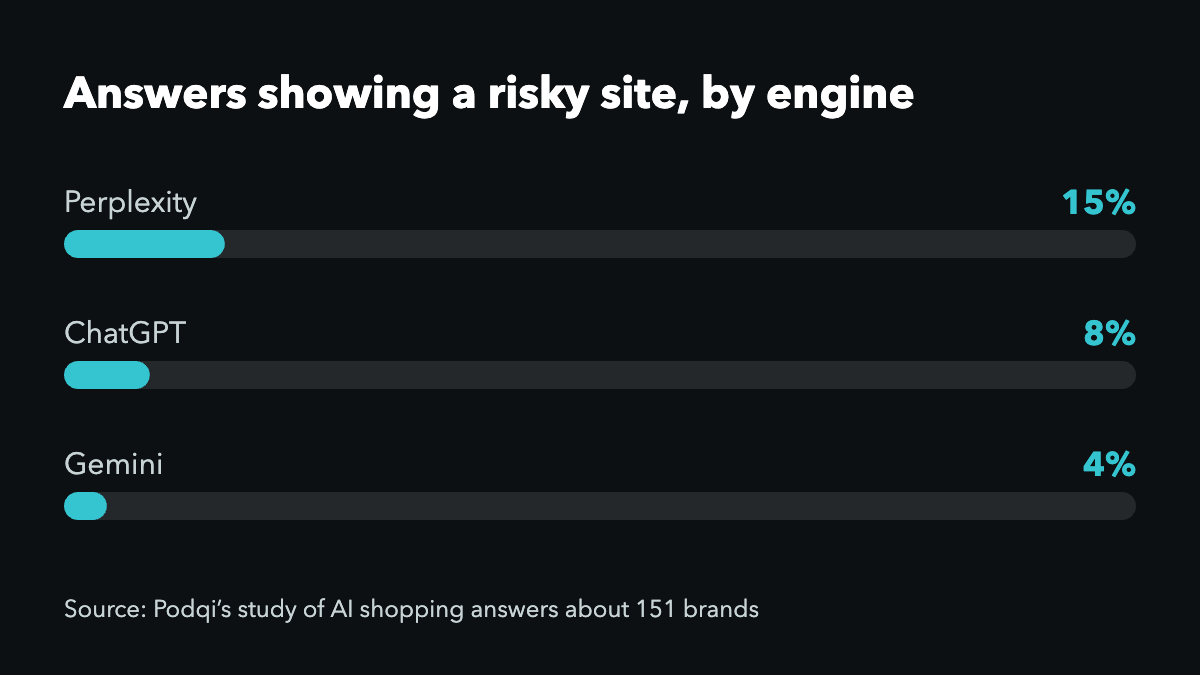
The engines aren't equal. In Podqi's data, Perplexity showed a risky site in 15% of its answers, ChatGPT in 8% and Gemini in 4%. Risk did drop between the two waves of fieldwork, from 12% to 7%, so the engines are improving. I wouldn't wait on them.
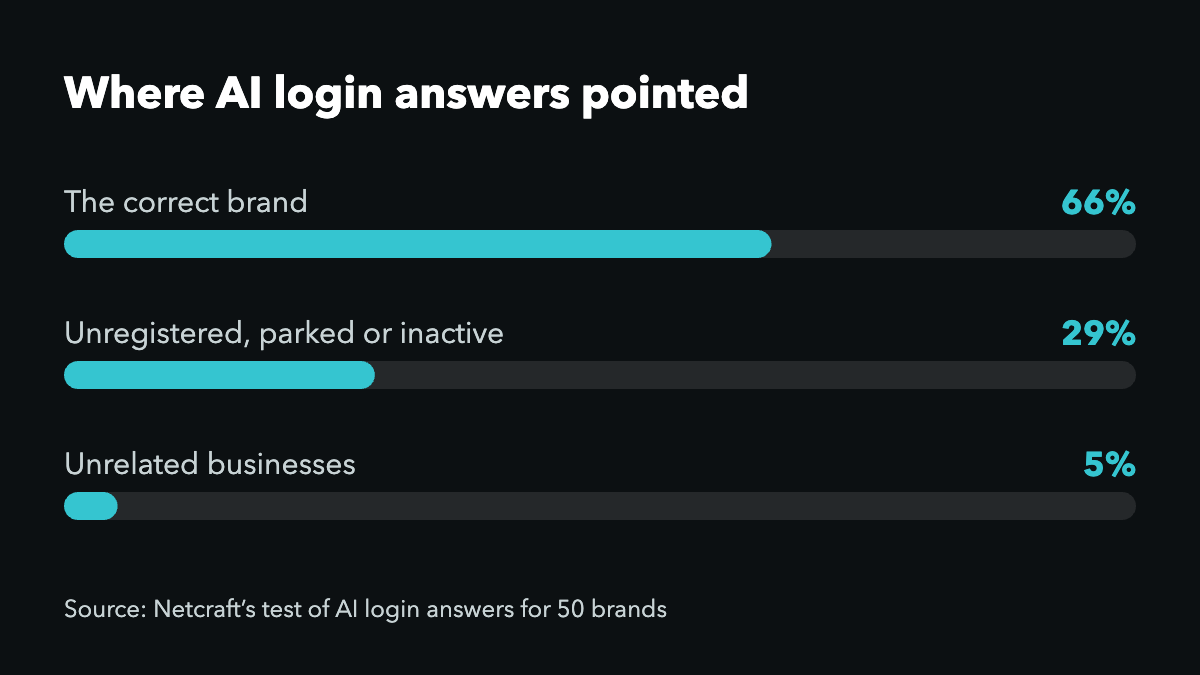
Login pages show the same pattern. Netcraft’s test of AI login answers for 50 brands asked a large language model where to log in to well known platforms. Only 66% of the domains belonged to the correct brand. 29% were unregistered, parked or inactive, leaving them open to takeover, and 5% belonged to unrelated businesses. In one real case, Perplexity put a phishing page hosted on Google Sites at the top when asked for the Wells Fargo login URL. Dead domains matter in shopping too: anyone can register a lapsed domain again, so an address AI keeps recommending could become a counterfeit storefront.
So whose job is it? Both. An LLM has a responsibility to give correct answers to the best of its ability. The company has a responsibility to do its part by publishing content that answers the questions customers want to know about the brand. The company can only control its side, so that's where I'd start.
Big brands are bigger targets
Size doesn't protect you. In Podqi's study, only 4 of 125 risky answers about enterprise brands warned the shopper. I think big brands are in some ways at more risk. A lot of people are typing in questions about your company, so competitors who want to steal traffic see you as a bigger target and have more incentive to put incorrect information out about you.
Smaller companies have a different problem. Netcraft found credit unions, regional banks and mid sized platforms fared worse than global giants, because smaller players are less likely to appear in LLM training data. For them, the first move is structure. Is your website designed to be easily read by LLMs? Are the facts you want picked up prominent on your site and easy to find?
Publish one page of official answers
The page I'd build starts with the basic questions customers ask and basic information about the business. If relevant, add pricing, billing, security and legal, the settled answers that don't need a longer discussion, and give the highest priority to the questions customers ask you most. More and more companies are already doing this, because content is increasingly being written so AI agents can digest it, and FAQs have become much more prominent as a result. I have noticed that when an FAQ page is done well, its questions show up in LLM answers.
Podqi recommends a crawlable official sites page listing every official regional store and authorized retailer, saying plainly which countries have no regional store, linked from the footer and help center. That fits their data. The riskiest question was whether a brand ships internationally and what its regional websites are, with 16% of those answers showing a risky site.
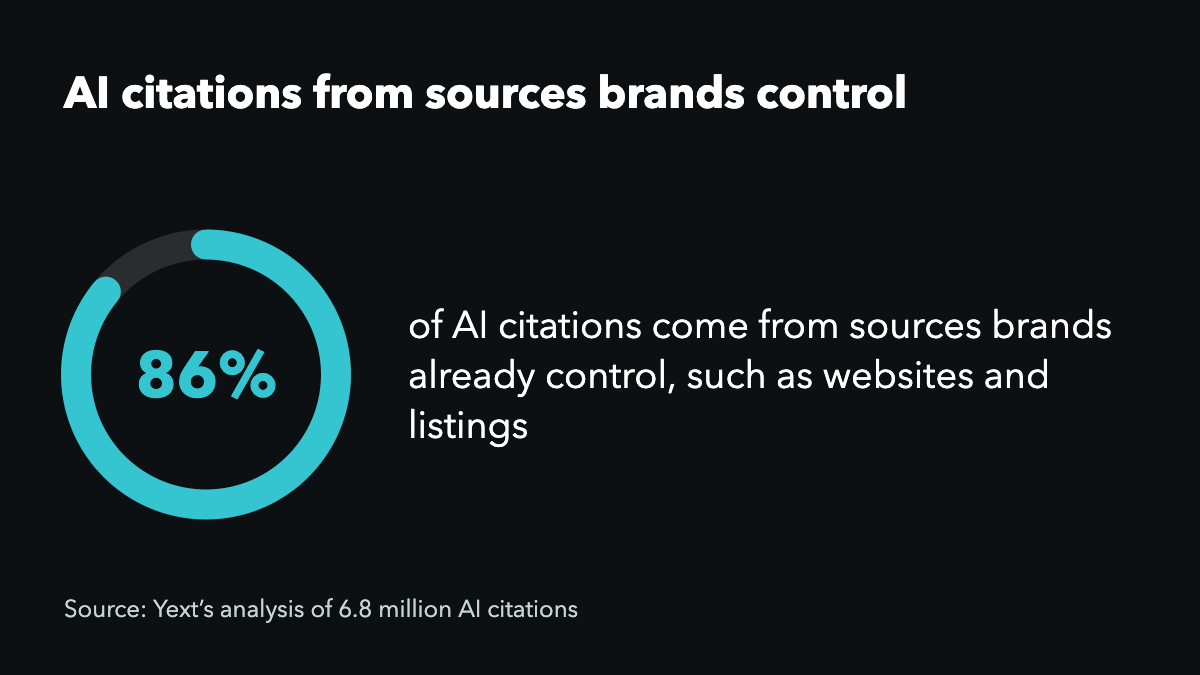
Your own site carries more weight than most teams assume. Yext’s analysis of 6.8 million AI citations found 86% of citations come from sources brands already control, such as websites and listings. First party websites alone generated 44% of citations, ahead of listings at 42%.
Leaders who write, and someone who checks
A fact page answers questions. Getting talked about takes something else. Ahrefs’ May 2025 study of 75,000 brands found brand web mentions show the strongest correlation with AI Overview brand visibility, at 0.664, far ahead of the number of backlinks at 0.218. A brand in the lower 50% of web mentions is essentially invisible to AI systems. The way to earn mentions is senior leaders producing first person content. Over time, the number one thing that's mattered in both traditional and LLM search is content from a subject matter expert with a unique perspective. Senior leaders are the people to produce it, and a competitor can't copy their experience. “One of the clients that we work with for our OnBrand solution, they haven't fully onboarded yet, but one of the problems that they came to us with was when they went to search for their head dentist, who runs the business, what ended up happening was the information about the dentist using an image of the dentist came back with somebody completely wrong and not the dentist who is running this business that we're trying to help improve their visibility for,” says Arun Koshy, Co-Founder OnBrand.
I've written before that people trust a person over a logo, and that a few hundred employees with unique perspectives beat thousands copy pasting the same message. The same holds for what AI engines read.
Then someone has to keep checking. Podqi suggests asking ChatGPT, Gemini and Perplexity your riskiest questions every month, logging every domain the answers surface and flagging any you don't operate. Whoever in the company is responsible for AEO and SEO should own that.
To make the case to leadership, look at the trend. More and more people are searching through LLMs. You can ignore it now, but you'll pay the cost more every year. This isn't a fad. LLM search is here to stay, and brands that don't get ahead of it will be severely behind over the next few years. The stakes are already visible: FTC’s 2025 imposter scam figures show people reported losing nearly $1 billion to business impersonators in 2025.
This week, start on the one pager. Find out what your riskiest AI prompts are and what your customers ask the most. Put that on a page, publish it on your website and make sure it's readable for LLMs. For more, visit our website at onbrandhq.ai.
Frequently asked questions
How often do AI shopping answers send people to fake or dead websites?
Podqi reviewed 6,795 answers from ChatGPT, Gemini and Perplexity about 151 brands and found 9% showed the shopper a risky website. Of 4,437 domains, 718 were risky: 351 fake and 367 dead. When a risky site appeared, 57% of answers recommended it as a place to shop and only 9% warned against it.
Why is being recommended to a fake store worse than not being recommended?
Because the engine will recommend something either way. If it can't pull from your brand, it pulls from somewhere else, and a wrong recommendation becomes a lost sale, a support ticket, a safety concern or a reputational hit. Your name gets used, but the customer ends up in the wrong place.
Does being a big brand protect you in AI answers?
No. Only 4 of 125 risky answers about enterprise brands warned the shopper. Big brands may face more risk, because so many people ask about them that competitors have more incentive to put incorrect information out. Smaller companies face a different problem: they're less likely to appear in LLM training data.
What should go on a page of official facts for AI engines?
The questions customers ask most, basic information about the business, and where relevant pricing, billing, security and legal answers. For brands that sell in several countries, list every official regional store and authorized retailer, say which countries have none, and link the page from the footer and help center.
Who should check what AI engines say about a company?
Whoever is responsible for AEO and SEO. Each month they should ask ChatGPT, Gemini and Perplexity the riskiest questions, log every domain the answers surface, and flag any the company doesn't operate.
How do you get a brand talked about in the places AI engines read?
Have senior leaders publish first person content. Brand web mentions correlate with AI Overview visibility far more strongly than backlinks, and first person content from a subject matter expert with a unique perspective is what a competitor can't copy.
AJ Agrawal is the co-founder of OnBrand, which helps companies with employee led answer engine optimization. Read more about OnBrand.