

The short answer: Yes, when it comes from named experts with something specific to say. Buyers now meet vendors through AI, but most check those answers against a company's own content before committing. Generic AI content is everywhere, so writing from real people, backed by evidence and case studies, is what builds trust, wins the deal and keeps the customer after it. Measure it by visibility and conversion, not traffic alone.
Read the transcript
I think that there's just such a lack of content that's being produced from thought leaders, and now with AI, everything is hidden behind just generic company messaging, that we've lost the human element of this whole thing. And so having an actual human respond, and being able for clients to get to know an actual human behind the company, is now more important than ever.
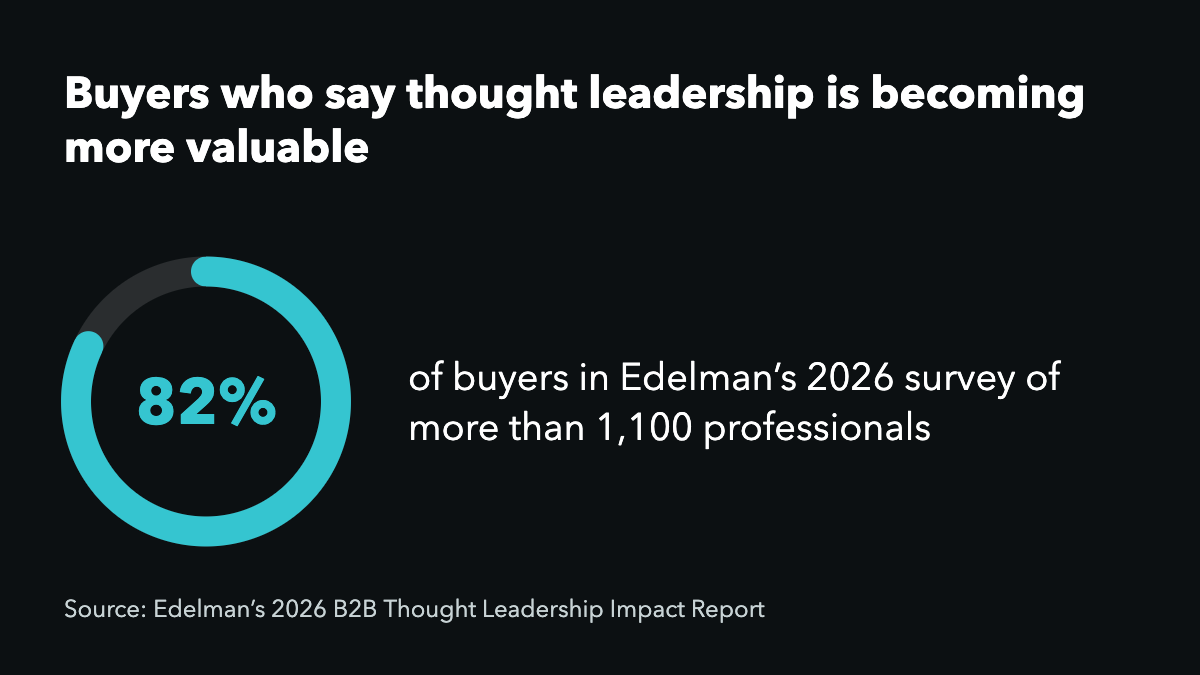
When I saw that 82% of buyers in Edelman’s 2026 B2B Thought Leadership Impact Report believe thought leadership is becoming more valuable, my reaction was that it completely makes sense. More and more generic content is being produced by AI, so content from an actual human being is worth more. Scarcity does the work.
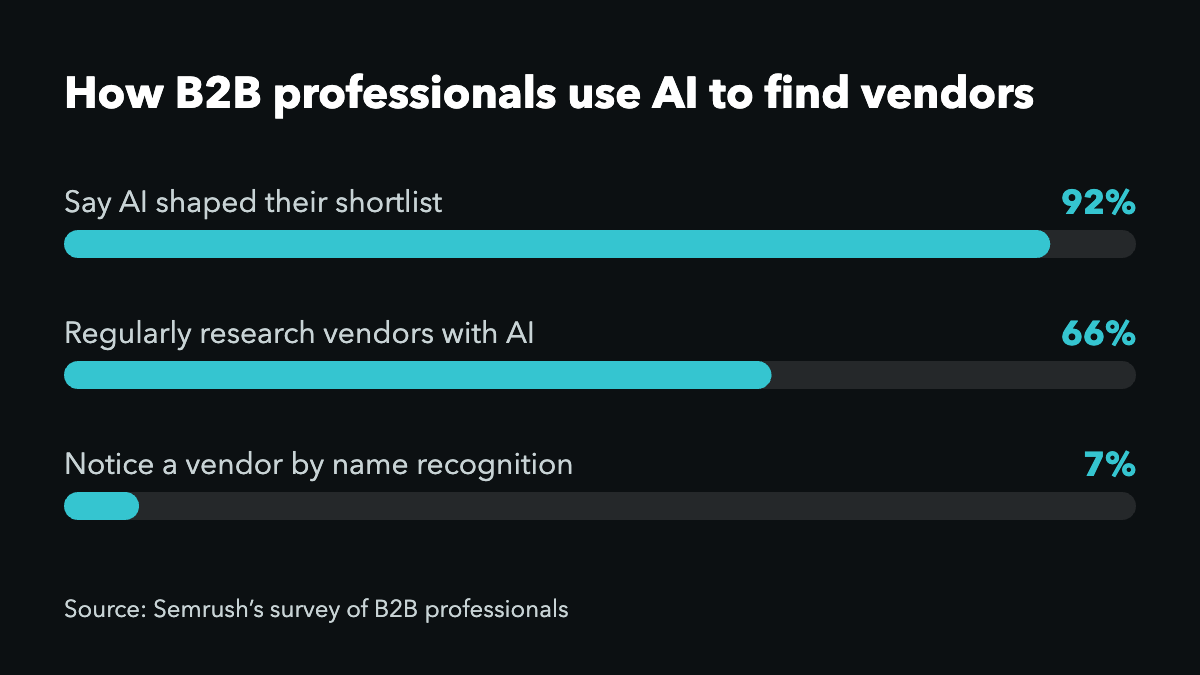
The way buyers find vendors has changed. Semrush’s survey of B2B professionals found that among people who use AI for work, 66% regularly use it to research vendors and solutions, and 92% say AI has shaped their vendor shortlist. That is where a company now gets introduced.
But the introduction is not the decision. TrustRadius’s 2026 B2B Buying Disconnect Report found 63% of buyers used AI during their purchase journey, and 94% of those fact check its responses at least some of the time. Edelman found most buyers still validate AI recommendations by referring to a brand’s content. AI gets you on the list. Your own experts decide whether you stay on it.
What buyers look for when they arrive
When a buyer clicks through to check an AI answer, I think they're looking for expertise, plus evidence and case studies from other clients. Anything that builds trust and makes them feel comfortable.
The strongest example I have is from my own buying. I read a founder's work until I felt like I knew them, while that founder was gaining a lot of notoriety. By the time we got on a sales call, I was just as much looking forward to talking to the person running the company as I was to finding out about its products. I felt like I already knew who they were before the call even started.
Case studies are the hardest part, especially early in a business. Solid proof takes time to collect, and after that first stretch it gets easier.
Fame is not the gate, which is good news for smaller companies. Semrush found only 7% of people notice a vendor in an AI response because they recognize the name. Small companies need to put out more thought leadership, and their founders and other leaders need to take the time to produce it, so they show up for the question based and information based queries buyers actually type. Then the people have to look credible when buyers arrive. I often find team pages with bios describing jobs someone left, and experts with real knowledge and no public trace of it.
The best person for the question writes it
Many companies put every piece under the CEO's name. I don't think all content should be written by the CEO. It depends on the topic and the viewpoint, and it should be written by whoever is the best person to answer the question. Buyers agree: in Edelman and LinkedIn’s 2024 study, 62% said high quality thought leadership is produced by a prominent or high quality expert. Expert, not title.
The same goes for launches. When a company announces something new, its sales lead, engineering lead and CTO should not all post the same message. Each should write from their own position and expertise, and it should all align at the brand level. I'd rather have a few hundred employees with unique perspectives than thousands copy and pasting the same post.
The posts that work come from someone with something to say about their job: a salesperson writing about a deal they lost, an engineer sharing what broke and how they fixed it. The company's job is to make that easy and safe, then get out of the way. Nobody should be graded on how often they post.
Don't go quiet after the sale
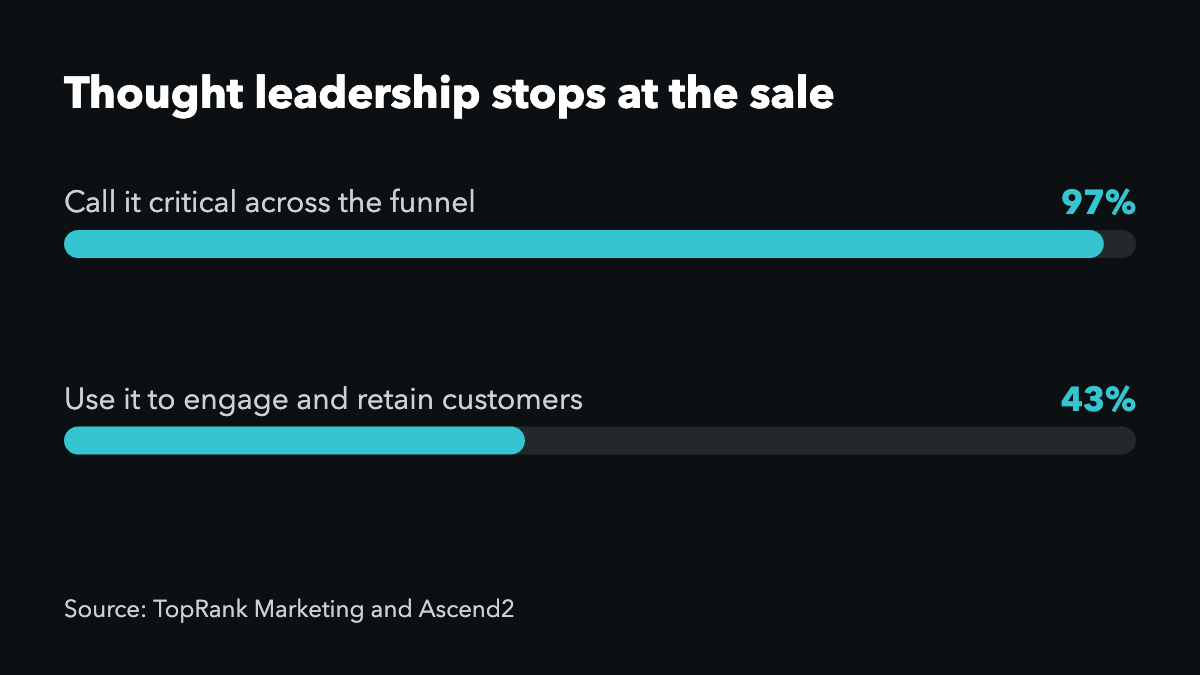
TopRank Marketing and Ascend2 surveyed just under 800 B2B marketers and found 97% say thought leadership is critical to full funnel success, yet only 43% extend it beyond acquisition to engage and retain customers. Companies that go quiet lose the ability to build a long term relationship with the client, and the contract value probably isn't as optimized as it could be. Getting the initial sale is great, but I think most money is made after it, by expanding the relationship.
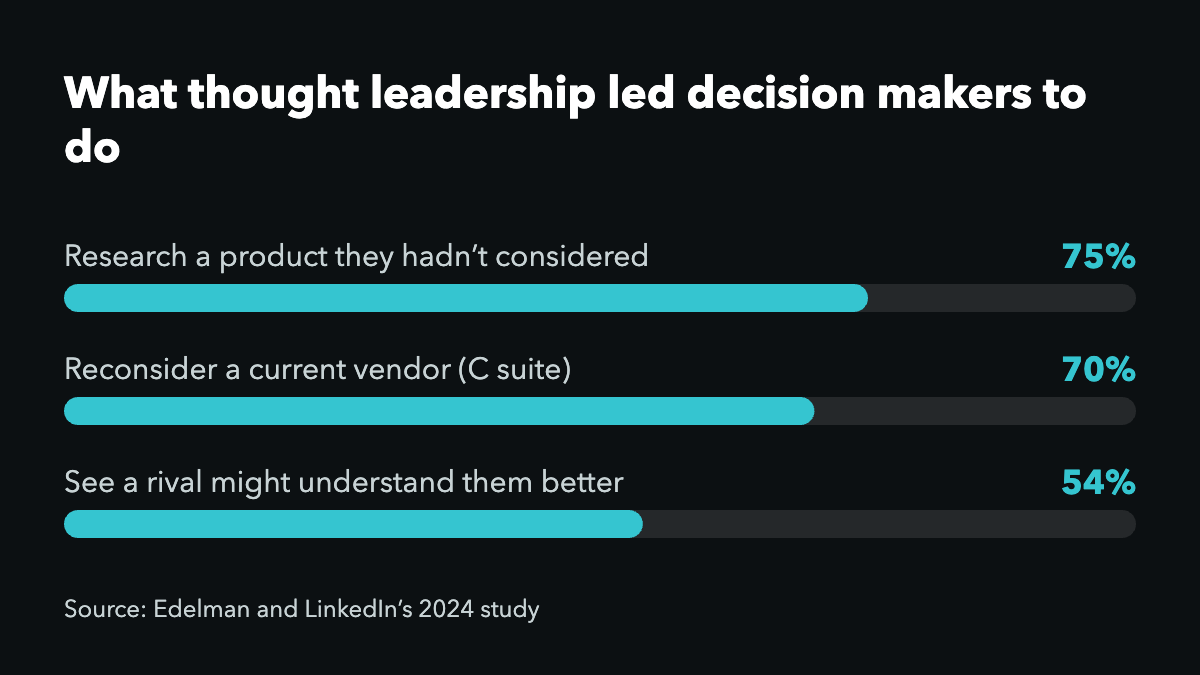
Silence also leaves the door open to competitors. In Edelman and LinkedIn’s 2024 study, 75% of decision makers said thought leadership prompted them to research products they had not considered, 70% of C suite executives said it led them to reconsider a current vendor, and 54% said it made them realize other vendors might better understand their needs. The protection is producing your own thought leadership on a consistent basis, with a workflow behind it that makes sure the work gets found in AI search.
A lot of this sharing happens where you can't see it. Edelman found buyers are more likely to share thought leadership in private channels. So I'd build a workflow that turns private conversations and meetings into content that can be shared publicly, with proper privacy and security in place so no sensitive data appears and any names that need it are anonymized.
How I'd measure it and where AI fits
In Edelman and LinkedIn’s 2024 study, 42% measured thought leadership only through web and social traffic, and just 29% could trace sales to specific pieces. I'd start with traffic, then do the best I can on visibility: which keywords and prompts is the work showing up for? Ideally you also track conversion. Share thought leadership with one group of leads, present none to another, and see whether the conversion rate goes up.
On format, I'd publish a wide range. I'd start with articles, share them as LinkedIn posts, add video for engagement, and turn them into decks for clients when the deal makes it relevant.
AI can help produce all of it, written or video. But I would never let AI write content without giving my own opinion first, and I would never let it publish without my review. The person offers the insight, then AI helps shape it and takes the tedious work away. Generic AI content is everywhere now. Specific writing from named people is what builds trust and wins the deal.
Frequently asked questions
Do B2B buyers still trust vendor content if they research with AI?
Yes. Semrush found 92% of B2B professionals who use AI for work say it has shaped their vendor shortlist, but most still verify. TrustRadius found 94% of buyers who used AI fact check its responses at least some of the time, and Edelman found most validate AI recommendations against a brand's own content.
What are buyers looking for on a vendor's site?
Expertise, evidence and case studies from other clients. Anything that builds trust and makes them comfortable. Credible people matter too: current bios, consistent profiles and experts who have a public record of what they know. A founder whose writing makes a buyer feel they already know them before a sales call is a strong pull.
Who should write a company's thought leadership?
Whoever is the best person to answer the question, not automatically the CEO. It depends on the topic and the viewpoint. When a company launches something, its sales lead, engineering lead and CTO should each write from their own position and expertise, aligned at the brand level rather than all posting the same message.
Why keep publishing thought leadership after the sale?
Most money is made after the sale by expanding the relationship. Only 43% of marketers extend thought leadership to engaging and retaining customers, and in Edelman and LinkedIn's 2024 study, 70% of C suite executives said a competitor's thought leadership led them to reconsider a current vendor.
How should companies measure thought leadership?
Start with traffic, then measure visibility by checking which keywords and AI prompts the work shows up for. Ideally, track conversion with a comparison: share thought leadership with one group of leads, present none to another, and see whether conversion rises. Only 29% of companies can currently trace sales to specific pieces.
AJ Agrawal is the co-founder of OnBrand, which helps companies with employee led answer engine optimization. Read more about OnBrand.